Company all-hands cost: pricing the whole-room meeting
All-hands scale headcount faster than any other meeting type. Estimate company-wide labor burn with level-mix scenarios and planning tips.

Alex Wong, Founder @ Wong Labs LLC
Published:
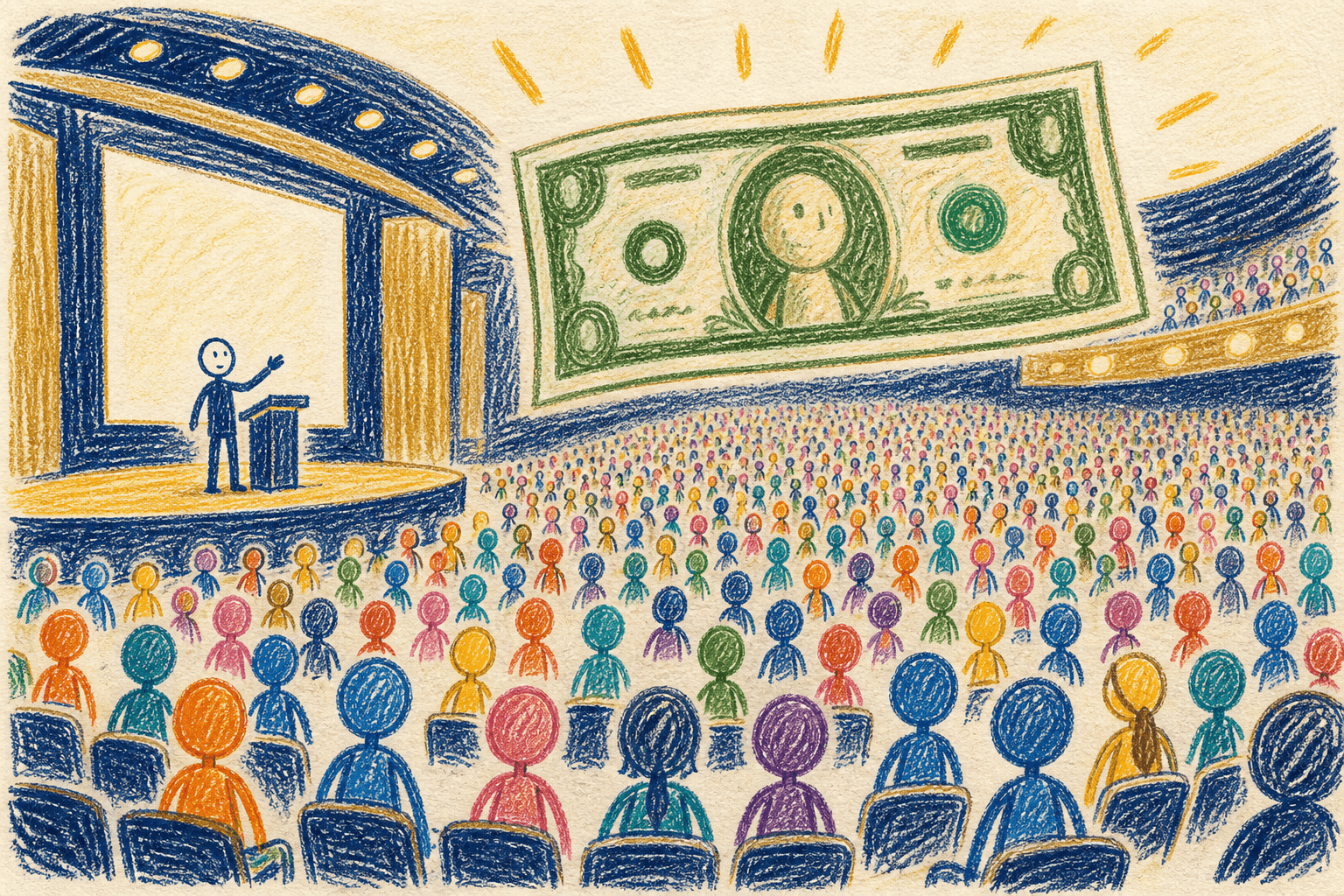
All-hands meetings are the extreme point on the meeting cost curve: maximum headcount × single synchronized block. Finance rarely books them as a line item; facilities counts chairs, not dollars. Yet a quarterly ninety-minute all-hands for a five-hundred-person product org can exceed the cost of many vendor contracts. Leaders should price all-hands explicitly before adding quarterly extras "for morale" or "investor narrative."
Why all-hands dominate cost
Meeterboard sums per-attendee per-second labor:
cost = Σ (tc_i ÷ 7,488,000 × seconds_present)
All-hands maximizes n. Even modest average TC yields huge totals because scale beats rate.
Illustrative models (not live data)
Model 1: homogeneous mid-level mix
500 attendees × $250,000 TC × 90 minutes (5,400 sec):
Per person: 250,000 / 7,488,000 × 5400 ≈ $180.13
Total: ~$90,065 per all-hands
Four per year → ~$360k annualized program cost in labor alone.
Model 2: realistic level spread
Assume 70% IC mid ($250k), 20% senior ($380k), 8% director ($550k), 2% exec ($800k) weighted average TC ≈ ~$285k:
Same 90 minutes, 500 people → ~$102k per session.
Model 3: post-hiring blast
600 people after growth, 60 minutes, higher senior mix post re-org → still six figures per occurrence.
Production AV, exec travel, and swag are not in these numbers.
Hidden all-hands multipliers
Preparation: Staff slides, rehearsals, comms dry runs—often dozens of hidden hours.
Recovery: Large syncs fragment deep work around them; not quantified here but felt.
Follow-on: "All-hands overflow" meetings when teams re-debate announcements.
Recording vs live: Recording does not erase live attendance cost when everyone still attends live "just in case."
When all-hands ROI is positive
- Crisis transparency requiring simultaneous trust repair
- Major strategy pivots where misinterpretation is costly
- Celebrating wins that materially affect retention
- Regulatory or compliance mandates
Negative ROI patterns:
- Reading metrics aloud available in dashboards
- Monthly cadence when quarterly suffices
- Inviting entire eng + go-to-market for deep eng-only roadmap detail
Design tactics to protect dollars and attention
Shorten default — 45 minutes with tight run-of-show beats ninety drifting.
Segment — org-specific Q&A breakouts instead of one giant forum.
Async-first narrative — CEO memo + short live Q&A only.
Level-aware scheduling — exec pre-record segments; ICs watch async; live for questions.
Measure — run a representative slice in Meeterboard (e.g. ten-person cross-level sample × headcount scaling factor). Rough but educates.
Using Meeterboard directly
You cannot import five hundred employees today. Workflows:
- Build a proxy meeting with ten attendees across bands matching company mix.
- Note ninety-minute cost; multiply by (N/10).
- Or run multiple smaller group meetings for regional all-hands—sometimes cheaper than fly-in culture.
Spectate won't show your internal all-hands but demonstrates live ticking psychology for smaller teams.
Communication ethics
Publishing all-hands cost internally can feel confrontational. Frame as respect for time rather than shame. "This forum costs us ~$X in collective focus—let's earn it."
Limits
Headcount and TC spread are estimates. Contractors and part-time employees skew math. Geo pay not modeled per individual.
Related
- Meeting ROI
- Reduce bloat
- How it works — formula and pause rules
Board and investor readouts
When presenting all-hands cost to a board, pair labor estimate with retention and clarity metrics if you have them (e.g. regrettable attrition, eNPS). Pure cost without narrative reads as "stop all-hands." Better frame: "We spend ~$X per quarterly all-hands in collective focus; employee surveys rank it #2 communication channel—cheaper than duplicated town halls per org."
Regional all-hands vs global
Multinationals sometimes run EU all-hands + US all-hands instead of one global—duplicating senior labor similar to timezone tax. Finance should compare: one 90-minute global (500 people) vs two 45-minute regionals (250 each) with different senior travel. Meeterboard proxy scaling helps either way.
After-party and social labor
Optional social time after all-hands is still synchronized labor if employees attend during work hours. A 30-minute informal mixer with 200 people at mids adds tens of thousands annually—worth it for culture, but price it knowingly.
Post-all-hands slack volume
Meeterboard cannot measure Slack debates after announcements. Qualitative retro: if every all-hands spawns hour-long thread arguments, true cost exceeds live room labor. Async FAQ doc released simultaneously can absorb shock.
Investor-only sessions
Some companies run a shorter investor update separate from employee all-hands—often senior-heavy and still six figures for thirty minutes. Price separately; do not assume employee all-hands substitute investor labor.
Translation and accessibility
Live interpretation for global all-hands adds vendor cost outside Meeterboard plus extended runtime if speakers pause for interpreters—duration bloat increases labor sync for everyone waiting.
Swag and production as separate budgets
T-shirts, streamed graphics packages, and executive video pre-production are cash expenses on top of labor totals here. Finance should budget three lines: AV/production, facilities/travel, and sync labor (Meeterboard)—not one blended "event cost."
Closing note
All-hands are the largest synchronized labor purchases most employees see. Treat them like any major spend: owner, agenda, timebox, and post-event review.
Try the calculator
Pick your company and level, add attendees, and watch the bill climb in real time.
Open Meeterboard →